
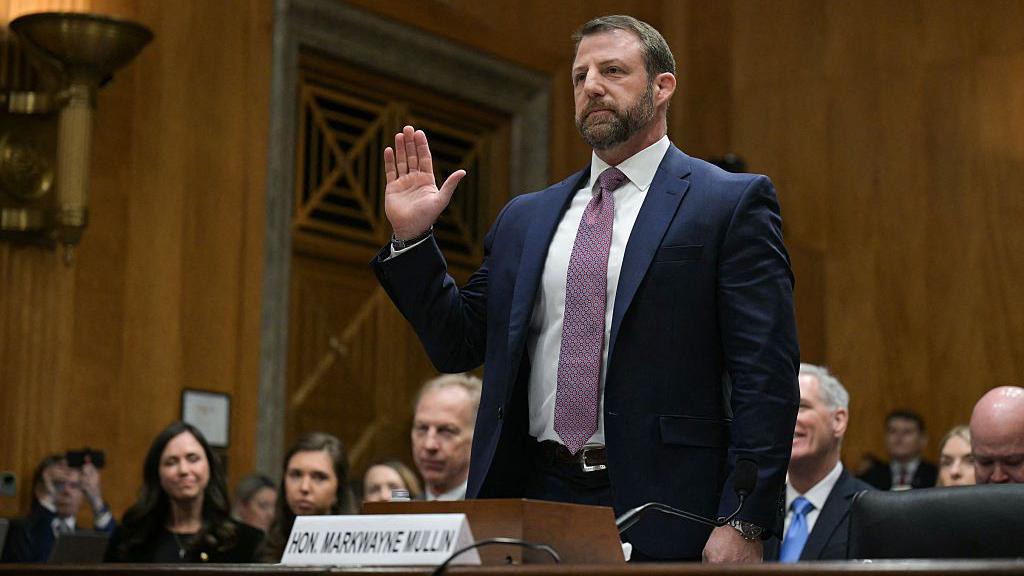
The confirmation of Senator Markwayne Mullin as Secretary of Homeland Security is not simply a routine cabinet appointment—it is a reflection of deeper structural tensions within American governance. At a moment when immigration, national security, and executive authority dominate political discourse, Mullin’s leadership represents both continuity and potential recalibration in federal policy. More importantly, his appointment offers a case study in how political identity, institutional pressure, and public opinion intersect to shape policymaking in the United States.
From Political Outsider to Policy Insider
Markwayne Mullin’s political trajectory is emblematic of a broader transformation in American politics. A former mixed martial artist and business owner, Mullin entered Congress as a political outsider, emphasizing anti-establishment rhetoric and aligning himself with populist currents within the Republican Party. His rise to one of the most powerful executive positions in the federal government underscores a growing trend: individuals with unconventional backgrounds are increasingly shaping complex policy domains traditionally dominated by career bureaucrats and legal experts.
This shift raises important questions about governance. Does outsider status enhance policymaking by bringing fresh perspectives, or does it risk oversimplifying highly technical issues? In the context of the Department of Homeland Security (DHS)—an agency responsible for everything from border enforcement to cybersecurity—the stakes of this question are particularly high.
Governing in a Moment of Institutional Strain
Mullin assumes leadership of DHS at a time of profound institutional instability. The department has faced budgetary uncertainty, operational challenges, and declining public trust. Agencies such as Immigration and Customs Enforcement (ICE) and the Transportation Security Administration (TSA) are not only tasked with critical security functions but are also at the center of intense political debate.
This environment complicates policymaking in two key ways. First, internal dysfunction limits the government’s capacity to implement policy effectively. Second, external polarization constrains the range of politically viable solutions. In other words, even well-designed policies may fail if the institutions responsible for carrying them out are weakened or politically contested.
For Mullin, this means that success will depend not only on policy design but also on administrative leadership—rebuilding morale, ensuring coordination across agencies, and restoring a sense of mission within DHS.
Immigration Policy at a Crossroads
Immigration remains the most politically charged issue under DHS jurisdiction, and Mullin’s appointment comes amid ongoing debate over enforcement strategies. Historically, he has supported strict border security measures, aligning with policies that prioritize deterrence and enforcement. However, his confirmation signals a potential shift toward a more nuanced approach—one that acknowledges legal constraints and public concerns about civil liberties.
This tension reflects a broader dilemma in public policy: how to balance security with rights. Aggressive enforcement strategies may achieve short-term reductions in unauthorized migration, but they often raise constitutional and humanitarian concerns. Conversely, more restrained approaches may protect civil liberties but face criticism for perceived weakness on border control.
The challenge for Mullin will be to navigate this tradeoff in a way that is both politically sustainable and legally sound. This is not merely a question of policy preference; it is a test of the government’s ability to reconcile competing values in a democratic system.
The Role of Public Trust
One of the most significant, yet often overlooked, dimensions of homeland security policy is public trust. In recent years, confidence in government institutions has declined, particularly among younger generations. This trend is especially relevant given the increasing prevalence of misinformation and the politicization of national security issues.
For a department like DHS, public trust is not optional—it is essential. Policies related to surveillance, border enforcement, and emergency response all depend on public cooperation and legitimacy. If citizens perceive these policies as unjust or politically motivated, compliance and effectiveness may decline.
Mullin’s leadership will therefore be judged not only by policy outcomes but also by his ability to communicate transparently and build credibility. In an era of viral misinformation and rapid news cycles, this task is more complex than ever.
Political Ramifications and Institutional Power
Beyond policy, Mullin’s appointment carries significant political implications. His departure from the Senate alters the balance of power, albeit marginally, and reflects the increasingly fluid relationship between the legislative and executive branches. In recent years, the movement of lawmakers into executive roles has blurred institutional boundaries, raising questions about accountability and separation of powers.
Moreover, the narrow margin of his confirmation highlights ongoing divisions within Congress. Even within his own party, dissent signals a lack of consensus on the direction of national security policy. This fragmentation may complicate future legislative efforts related to DHS funding and reform.
A Broader Reflection on American Governance
Ultimately, Mullin’s appointment is about more than one individual—it is about the evolving nature of American governance. It illustrates how political identity, media narratives, and institutional constraints interact to shape policy outcomes. It also underscores the difficulty of governing in a polarized environment, where even basic administrative decisions can become politically contentious.
For students of public policy, this moment offers an important lesson: effective governance requires more than strong opinions or electoral success. It demands institutional competence, legal awareness, and the ability to navigate complex tradeoffs under public scrutiny.
Conclusion: A Defining Test
As Secretary of Homeland Security, Markwayne Mullin faces a defining challenge. He must lead an agency at the intersection of some of the most contentious issues in American politics while restoring its functionality and credibility. His success or failure will not only shape immigration and national security policy but will also influence broader perceptions of government effectiveness.
In the coming months and years, one question will remain central: can leadership bridge the gap between political ideology and practical governance? The answer will have lasting implications—not just for DHS, but for the future of public policy in the United States.
 Public Policy With Talia
Leave a comment