
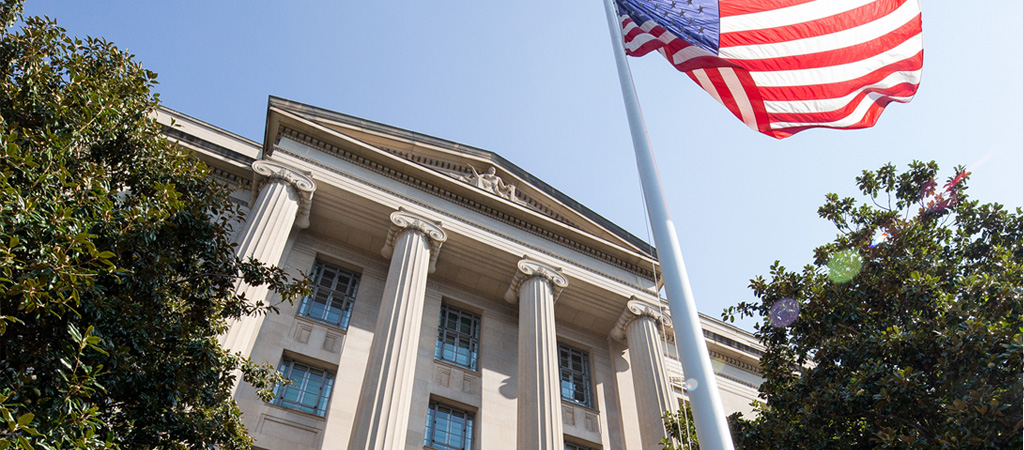
When people think of public policy, they often think of Congress passing laws or a president signing an executive order. However, policy does not exist in reality until laws are enforced, and this is where the United States Department of Justice comes in.
The United States Department of Justice, commonly referred to as the DOJ, is one of the most powerful and influential organizations in the government. The DOJ’s official mission is engraved on its headquarters in Washington, D.C.: “Equal Justice Under Law.” The four words encapsulate the DOJ’s role in the government, but living up to this role is far from easy.
An Institution Built to Enforce the Law
The DOJ was created in 1870 during Reconstruction. The government realized then that laws were insufficient in protecting citizens’ rights, especially newly freed slaves. The government needed a centralized organization to enforce laws across the nation and fight against government abuse.
Today, the DOJ is the government’s top law enforcement organization and its legal representative in court. It is responsible for prosecuting federal crimes, defending the United States in court when laws are challenged, and explaining how laws should be applied in everyday life. The DOJ is both a legal and a policy organization.
How the DOJ Shapes Public Policy
While the Department of Justice does not make laws, it is a key player in shaping policy. The DOJ’s decision on whether to prosecute a case, whether to investigate a certain organization, and its legal interpretation of laws all demonstrate its influence in shaping policy.
For example, if the DOJ enforces voting rights laws vigorously, democracy is enhanced. If they bring antitrust cases against large corporations, they shape markets. If they investigate police departments for civil rights abuses, they shape how policing is conducted across America.
This means that DOJ activity or inactivity can have just as great an impact as legislation.
Civil Rights at the Center
One of the most impactful tasks of the DOJ is enforcing civil rights. This means protecting Americans from discrimination in voting rights, education, housing, employment, and policing through lawsuits, consent decrees, and investigations.
These cases are highly politicized because they involve highly contested questions of federal power, state’s rights, and social equality. However, they also demonstrate DOJ’s central role in ensuring that constitutional rights are not simply abstract concepts but are actually enforced.
Independence, Politics, and Trust
As a part of the executive branch of government, the DOJ must always walk a tightrope of balancing independence with politics. The Attorney General answers to the President but must also ensure that justice is enforced without regard to favor or politics.
This is why DOJ investigations—particularly those of public officials—are always front-page news. This is because they raise very serious questions of justice and independence. Can justice ever be independent? Should anyone be held above the law? How independent must they be to truly serve democracy?
Public trust of the DOJ requires that they appear to be motivated by law and not politics.
Why the Department of Justice Matters
The Department of Justice is not just a law enforcement agency. It is a guardian of democracy, a maker of public policy, and a test of whether “equal justice under law” is a promise or a reality.
If you are a young person interested in law, politics, and/or civic participation, the DOJ is a window into how power really works in the United States—after the speeches, after the laws are passed.
Because, in the end, justice is not defined by what is written on paper. Justice is defined by who enforces it—and how.
 Public Policy With Talia
Leave a comment