
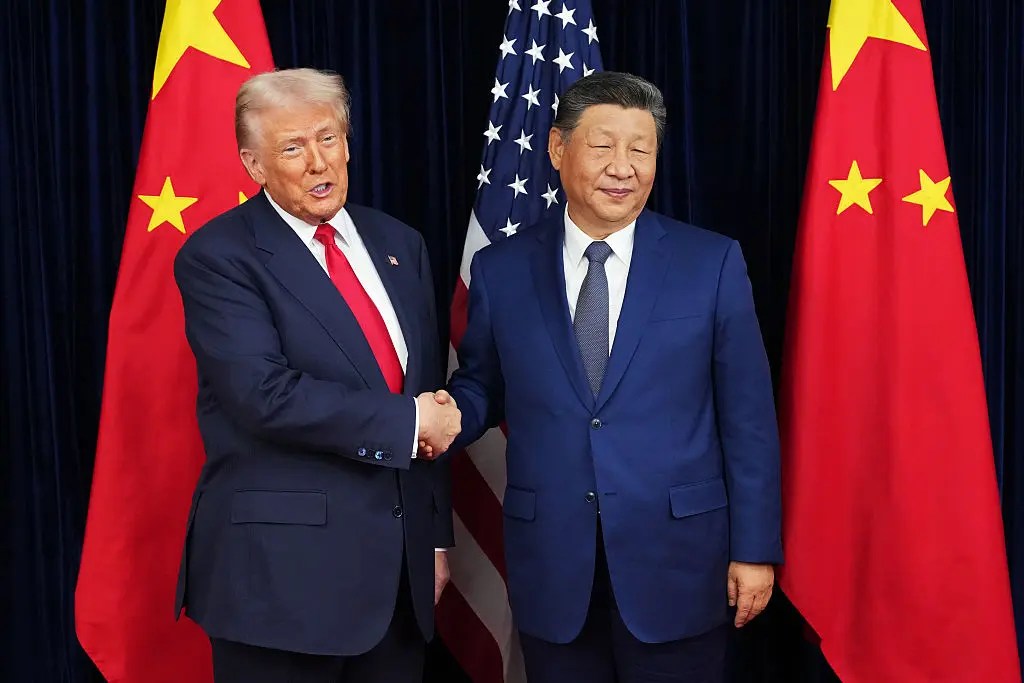
On October 30, 2025, former President Donald Trump and Chinese President Xi Jinping met in Busan, South Korea, for their first face-to-face meeting in over five years. The encounter produced what both leaders called a “framework agreement” — a tentative deal meant to stabilize trade relations between the world’s two largest economies. Trump praised the meeting as a “12 out of 10,” while Xi emphasized the importance of “mutual respect and cooperation.” Behind the positive headlines, however, lies a complex question: is this the start of a real reset, or simply a pause in a long-running rivalry?
At the center of the deal is a temporary truce on tariffs. The United States agreed to suspend a planned 100 percent tariff hike on Chinese goods, while China promised to lift restrictions on certain American exports, particularly agricultural products such as soybeans. Both sides committed to reviewing the agreement annually rather than making permanent changes — a move that offers flexibility but also creates uncertainty. For now, the decision eases economic tensions and reassures global markets, but the lack of a long-term framework means instability could return at any time.
Another key element involves rare earth minerals, the critical materials used in everything from smartphones to fighter jets. China currently controls about 70 percent of the global supply, giving it enormous leverage in global technology and defense industries. As part of the new understanding, Beijing agreed to suspend new export licensing requirements for at least a year, providing short-term relief to U.S. manufacturers who depend on these resources. The move is significant, but it also highlights the depth of America’s reliance on Chinese exports and the challenge of achieving true supply-chain independence.
Both Trump and Xi walked away with symbolic victories. For Trump, the deal reinforces his image as a negotiator capable of reducing tensions without conceding strength. For Xi, it signals that China continues to shape global economic policy even as Western governments attempt to limit its influence. Each leader benefits politically at home while projecting confidence abroad — but beneath the diplomacy lies a cautious awareness that mutual trust remains fragile.
What the agreement does not include may be just as important as what it does. It leaves unresolved long-standing disputes over intellectual property, semiconductor export restrictions, and human-rights concerns. These omissions show that while both sides are eager to calm economic tensions, they are avoiding the deeper structural and ideological conflicts that define the modern U.S.–China relationship.
The outcome of this meeting is less a breakthrough and more a moment of strategic restraint. By choosing a flexible framework rather than a binding treaty, both countries have bought themselves time — but not necessarily progress. The world may see a brief period of stability in trade and investment, yet the underlying competition for technological and geopolitical dominance remains unchanged.
Ultimately, the Busan meeting is a reminder that diplomacy often moves in pauses, not leaps. This so-called “12 out of 10” success marks a temporary stabilization rather than a lasting resolution. The future of U.S.–China relations will depend on whether these annual negotiations evolve into genuine cooperation or dissolve back into the familiar cycle of tariffs, tensions, and political posturing. For now, the world watches — hopeful, but wary — as two superpowers balance between collaboration and competition in a fragile new era of global policy.
Works Cited
Bremmer, Ian. “Trump and Xi’s Meeting in South Korea Marks a ‘12 Out of 10’ Moment for U.S.–China Relations.” TIME, 30 Oct. 2025, https://time.com/7329777/trump-xi-meeting-korea-us-china-trade-deal-tariffs-takeaways/.
Leonard, Peter. “China’s Rare Earths and the Global Supply Chain: A Strategic Weak Point.” Foreign Policy, 12 Sept. 2025, https://foreignpolicy.com.
Miller, Claire. “Tariffs, Trade, and Technology: Inside the Shifting U.S.–China Economic Strategy.” The Wall Street Journal, 31 Oct. 2025, https://www.wsj.com.
Zhang, Ling. “China’s Role in the Rare Earth Market: Policy, Power, and Global Impact.” Brookings Institution, 8 July 2025, https://www.brookings.edu.
 Public Policy With Talia
Leave a comment